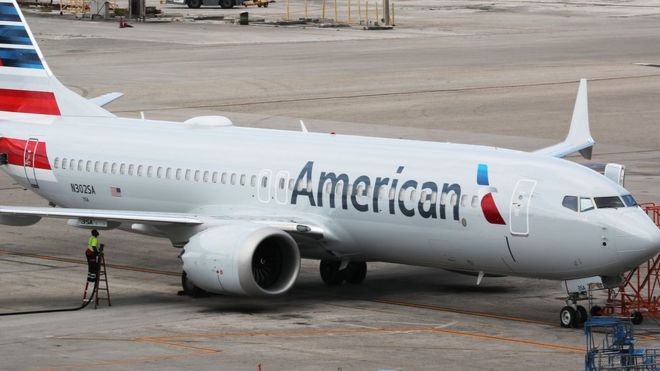
US regulators considered grounding some Boeing 737 MAX planes last year after learning of a problem with a system that is now the main suspect in two deadly crashes, a source close to the matter said. US regulators considered grounding some Boeing 737 MAX planes last year after learning of a problem with a system that is now the main suspect in two deadly crashes, a source close to the matter said.
Investigators in the Lion Air crash in October off the coast of Indonesia and the Ethiopia Airlines disaster in March have zeroed in on the planes' anti-stall system, called the Maneuvering Characteristics Augmentation System, or MCAS.
Last year, inspectors with the Federal Aviation Administration discovered Boeing de-activated a signal designed to advise the cockpit crew of a malfunctioning of the MCAS system, the source said.
The inspectors were in charge of monitoring Southwest Airlines, the biggest user of 737 MAX planes, with a fleet of 34 of them at the time, added the source.
Before the Lion Air crash, which killed all 189 people on board, "the (signals) were depicted as operable by Boeing on all MAX aircraft" regardless of whether the cockpit crew thought they had them turned on or off, said a Southwest spokeswoman.
She said after the accident, Boeing told Southwest the signals were "turned off unless they were specifically designated as being turned on" -- prompting the airline to choose that option for all its aircraft.
It was at that point inspectors learned Boeing had opted to make the malfunction alert an optional extra costing more money -- and had deactivated the signal on all 737 MAX delivered to Southwest without telling the carrier.
They considered recommending grounding the planes as they explored whether pilots flying the aircraft needed additional training about the alerts, said the source.
They decided against that -- but never passed details of the discussions to higher-ranking officials in the FAA, the source said, confirming a story in The Wall Street Journal.
- A costly grounding -
The FAA would not comment on the planes coming close to being grounded last year.
The Ethiopia Airlines crash left all 157 people on the plane dead and led to all Boeing 737 Max planes all over the world being grounded. In this case too the MCAS is being looked at as a possible cause of the crash.
In times of mid-air distress, the system is supposed to activate on its own and push the nose of the plane down to keep it from stalling.
Boeing is working on changing the MCAS so it can get the planes back in the air.
The grounding has already cost the carrier a billion dollars, Boeing said last week.
But the bill will probably climb because Boeing is expected to pay money to airlines forced to cancel thousands of flights and hire more reservations and services staff.
Boeing has suspended deliveries of Boeing 737 Max planes and cut production of them by 20 percent.
Neither of the Boeing 737 Max planes in the Lion Air crash in Indonesia or the Ethiopian Airlines crash were equipped with the signal that is supposed to show a malfunctioning of the MCAS, an industry source told AFP in March.
Called "disagree lights" in Boeing parlance, these lights turn on when faulty information is sent from so-called angle of attack sensors to the MCAS. Those sensors monitor whether the wings have enough lift to keep the plane flying.
"As we return to service, all customers will have the AOA disagree alert as standard and have the option to include the AOA indicator at no cost. This change will be made to all MAX aircraft -- production and retrofit," Boeing told AFP in a statement Sunday.
"A new software update will separate those two features, making AOA disagree alert a standalone standard feature and keeping AOA indicator as an additional customer-selected option."
In the case of the Lion Air crash, investigators think one of the angle of attack sensors may have failed and sent incorrect data to the MCAS, causing its nose to go down as pilots fought to bring it back up.
The MCAS overrides the pilots manual efforts to point the plane up or down.
With the angle of attack sensor not working properly, the thing to do would have been to turn off the MCAS. But the Lion Air cockpit crew did not know that.
Comments
Post a Comment